Project · Open Source
Interview Prep Kit
A local-first app for prepping across multiple interviews at once. It reads your resume and each job description, then generates stage-by-stage prep docs, a behavioral flashcard deck, and an audio coach that scores how you actually answer out loud. You bring your own API key, and nothing leaves your machine.
The problem
I was interviewing for several roles at once and my prep was scattered across four places: notes in Google Docs, practice questions in a Claude thread, job descriptions in tabs, and stories I kept rewriting from scratch. Every session started the same way, re-explaining which company I was interviewing with and hoping I was in the right project.
The actual problem wasn't note-taking. It was grounding. Good prep depends on the model knowing your real experience and the real job posting at the same time, and I was rebuilding that context by hand every single time.
The first version
I built the first version in under 24 hours in Cursor, the night before an interview. One job, hardcoded into a config file. Context files on disk. Prep docs generated by pasting a prompt into an AI IDE and committing the output.
It worked. I used it for that interview and it was better than what I had been doing. But it was a tool with exactly one user and exactly one job in it.
What broke
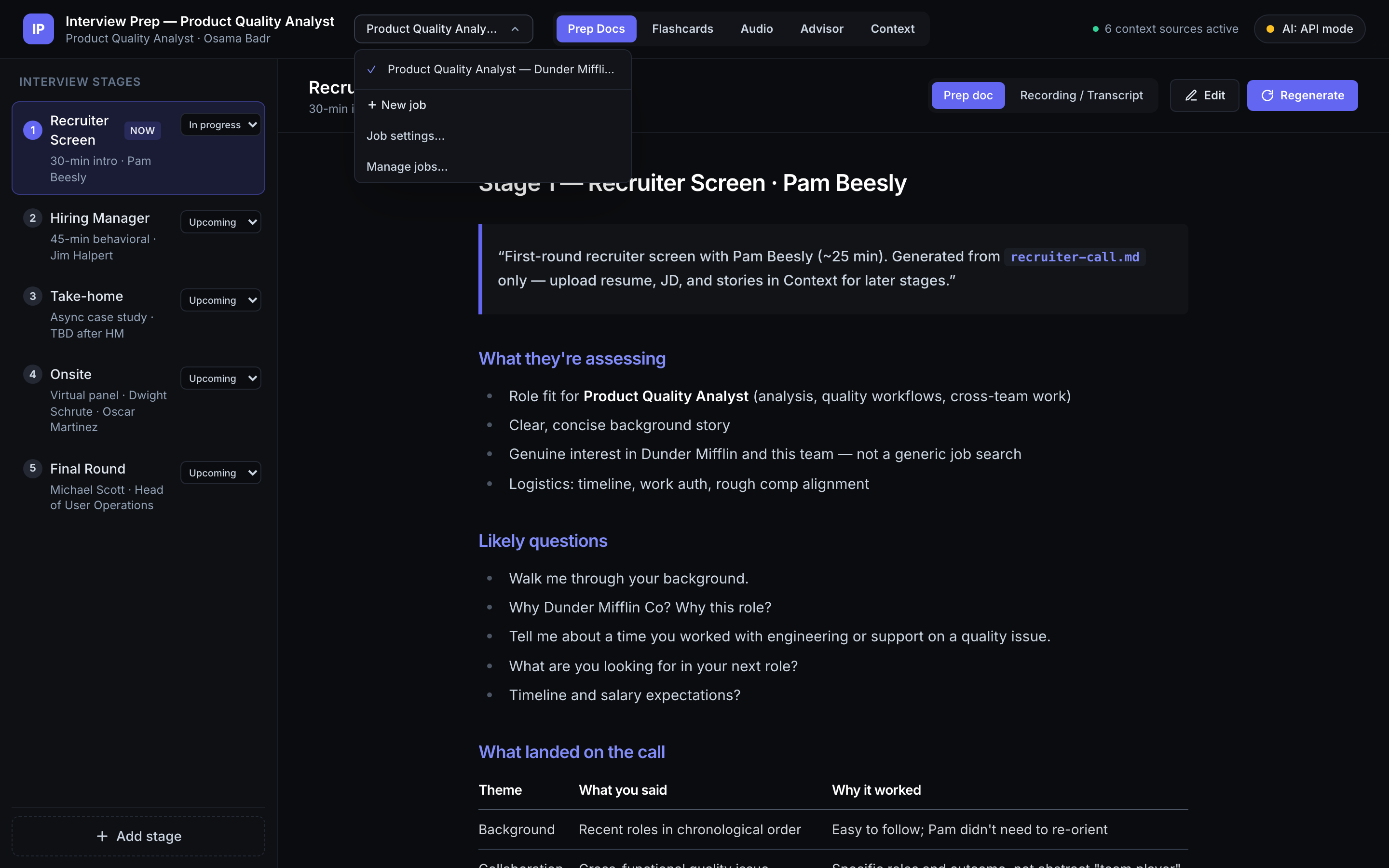
I had three live interviews running in parallel and the app could only hold one. Everything lived in flat browser keys with no namespace, so a second job would have overwritten the first: one flashcard deck, one set of prep docs, one advisor history. Prep for Company A and prep for Company B were the same storage.
Fixing that meant more than adding a dropdown. Every feature read and wrote global state, so a job had to become a first-class thing the entire app was scoped to — and the change had to land without losing the prep I was actively using that week.
Key decisions
Decision 01
Browser storage, not a serverA server-backed version would have been easier to build and would have killed the main promise. The whole pitch is that your resume and interview notes stay on your machine, and the moment there's a database there's a thing to trust. IndexedDB and localStorage behave identically on localhost and on a static host, so the same build runs on a laptop or behind a static host with no server at all. Everything goes through one storage adapter module, so if cross-device sync is ever worth it, it slots in behind that interface instead of touching every feature.
Decision 02
Migration before featuresThe first PR shipped no visible features. It moved every flat storage key into a job namespace and wrote a versioned migration for it. I was running my own live prep data in this app while rebuilding it, so a migration bug meant losing real work the week of real interviews. The migration is idempotent, non-destructive, and keeps the old keys until the new write is confirmed. Boring, and the reason nothing was lost.
Decision 03
One profile, attached by referenceYour resume and stories don't change per job, but the tailoring does. So the profile lives once and each job attaches the entries it needs by reference, meaning an edit to your resume propagates everywhere automatically. When a job needs a tailored version, "detach and edit" copies the content into that job and breaks the link. Same pattern as an override on a base config, applied to prep material.
Decision 04
Generation in the app, not in an AI IDEThe original flow required an AI coding assistant to write your prep docs. I moved generation into an onboarding wizard: name, profile, job, stages, attach context, generate. For anyone without an API key, paste mode copies the assembled prompt to your clipboard and takes the reply back, so the app still works with nothing but a browser and a chat window. The old prompt-driven path stayed in the README as a power-user route rather than the default.
Decision 05
Treat a side project like productionThe rebuild touched storage, routing, onboarding, and settings at once, in an app I was depending on that same week. So it shipped in small reviewable slices rather than one big change, with my own qa-agent run over each before it merged. The repo had no tests when this started; it has a suite now covering the storage adapter, the migration, profile attach and detach, and context assembly. That's the part I'd point at in an interview: not that the app works, but that I treated a side project like something that could break someone's week.
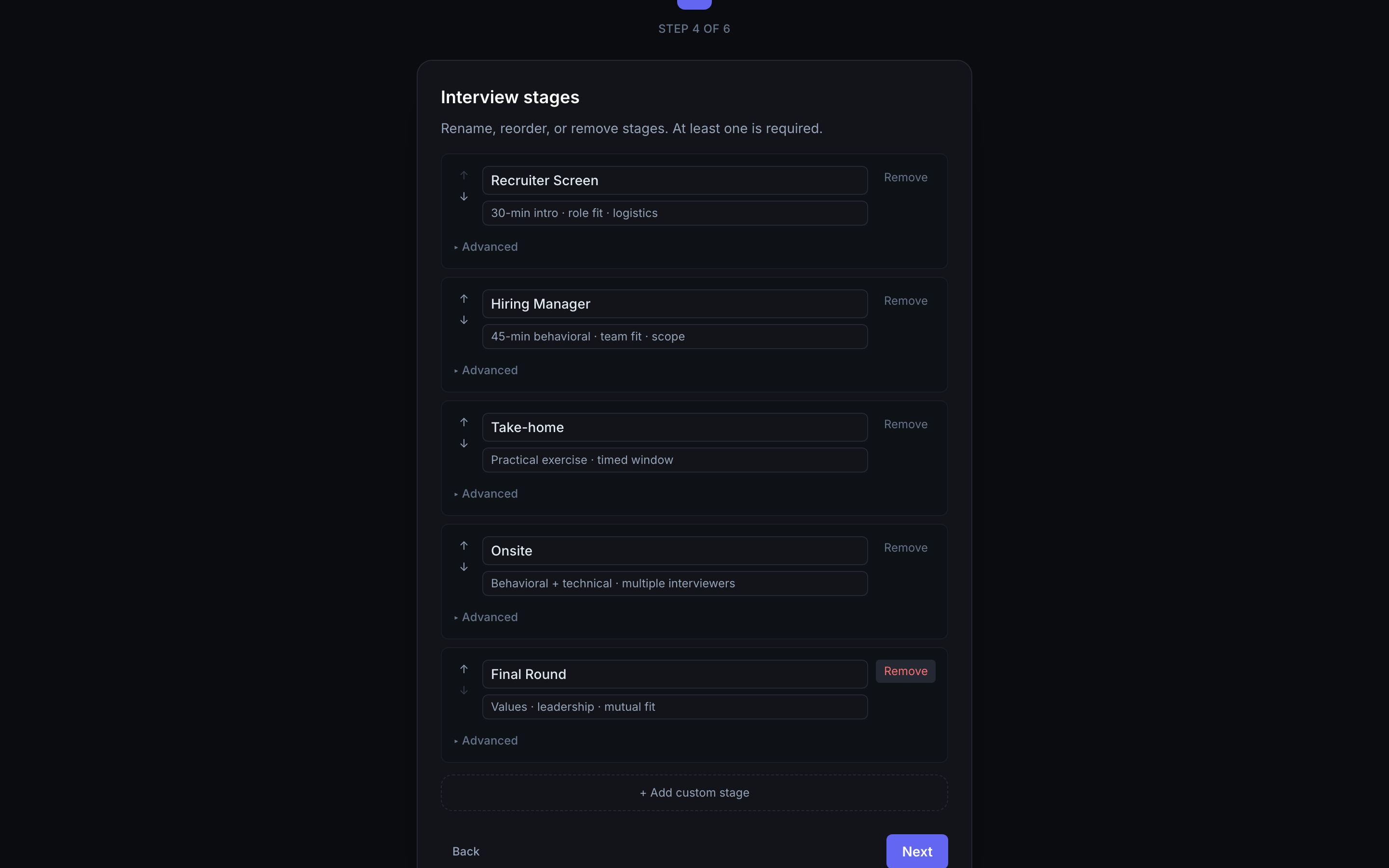
Onboarding — stages are edited in the app, not in a config file
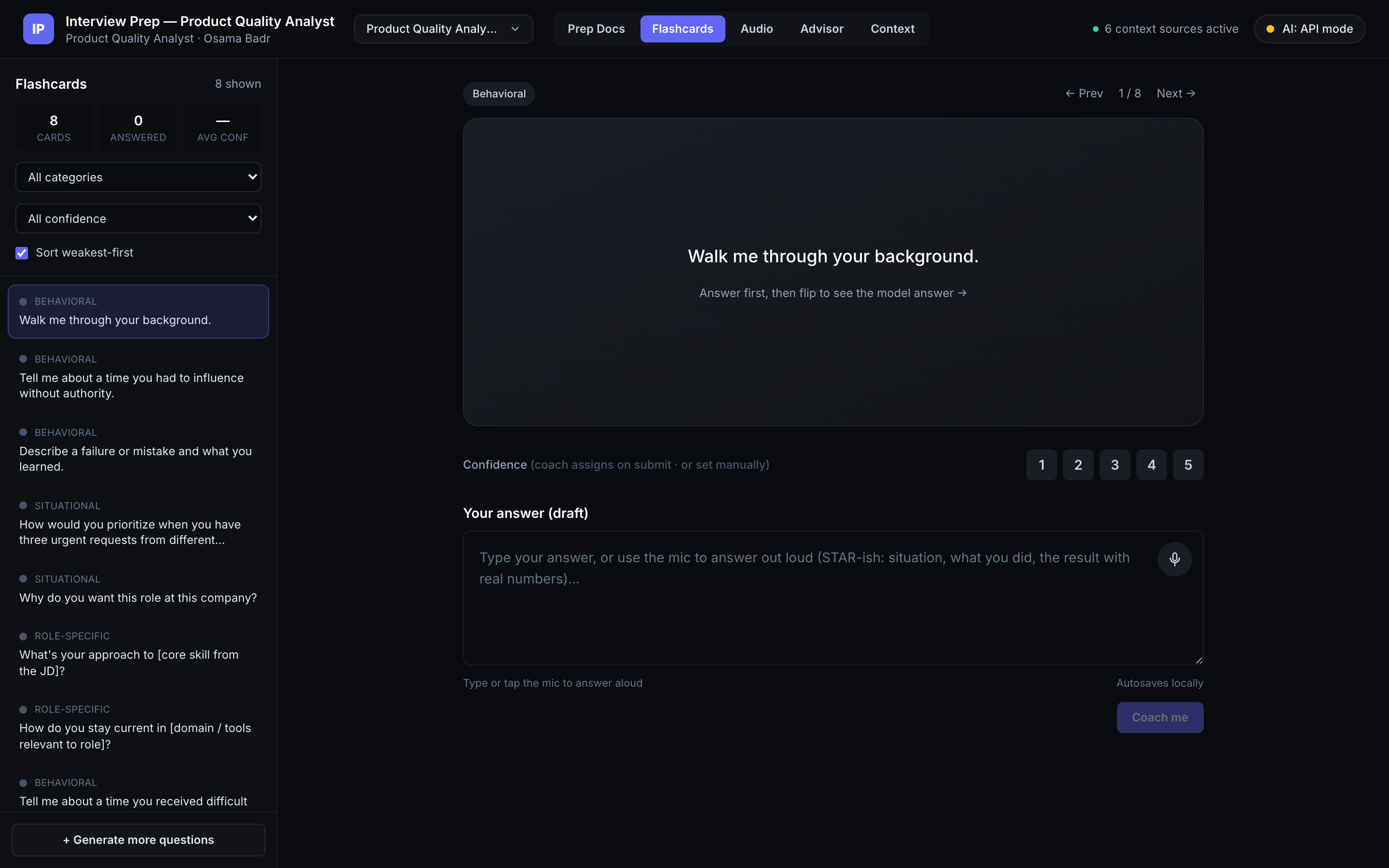
Flashcards — answer by typing or out loud, then get coached on it
How it works
Six surfaces, all scoped to whichever job you have active. Switching jobs swaps every one of them.
| Surface | What it does |
|---|---|
| Prep Docs | One doc per interview stage, editable and regeneratable on demand |
| Flashcards | Behavioral deck with AI coaching on the answer you actually gave |
| Audio | Record an answer, transcribe it, score structure and delivery |
| Advisor | Multi-turn chat that proposes new flashcards and context updates |
| Context | Paste, upload markdown or PDF, or pull a job description from a URL |
| Jobs | Switch between jobs; each keeps its own docs, deck, history, and recordings |
Where it stands
Public, MIT licensed, and runnable in about two minutes with a free Gemini key. There's a sample setup with demo data so you can see the whole flow before entering anything real.
What's next is a hosted version on its own domain — make an account, add your resume and the job you're chasing, and start prepping. No cloning, no terminal, no API key of your own. Right now the people who benefit most from this are the ones least likely to clone a repo to get it, and that's the wrong filter.
Local-first doesn't go away. It's the reason the app is worth handing your resume to, and running it entirely on your own machine stays supported. Hosting is about removing the setup, not the guarantee.
Deliberately unfinished: server-side transcription still falls back to the config's default job rather than the active one, and there's no component-level test coverage. Both are known and written down rather than discovered later.
I'm still using it. Every interview I run through it surfaces something the last version handled badly, which is the only reason it keeps getting better.